CLX SIMS: Sensor Integrated Monitoring System for Intelligent Airport Operations
Executive Summary
Airport gate operations rely on a complex network of electromechanical systems, varied control platforms, and operational processes that must function with high reliability and precision. Despite this, many airports continue to operate with limited system-level visibility, relying on localized HMIs and reactive maintenance practices that do not provide a complete picture of performance.
CLX SIMS (Sensor Integrated Monitoring System) addresses this gap by introducing a structured, data-driven monitoring architecture that integrates directly with existing control systems while extending visibility through sensor-based instrumentation and centralized analytics.
SIMS combines:
Direct PLC and VFD integration
Distributed sensor networks at the gate level
A centralized Upper-Level platform for visualization, alarms, and reporting
This approach enables airports to move beyond isolated system monitoring toward a unified operational environment, improving situational awareness, reducing downtime, and enabling predictive, condition-based maintenance strategies.
Introduction: The Challenge of Fragmented Gate Systems
Airport gate infrastructure consists of multiple interdependent systems, including:
Passenger Boarding Bridges (PBB)
Pre-Conditioned Air (PCAir) units
Ground Power Units (GPU)
Docking guidance systems (VDGS / Safegate)- where so equipped
Control panels and supporting electrical systems
While these systems interact operationally, they are typically monitored independently. Data is often confined to local PLCs or HMIs, limiting the ability to:
Correlate events across systems
Analyze performance trends over time
Identify root causes of operational issues
Optimize maintenance and resource allocation
This fragmented approach introduces inefficiencies and risk, particularly in high-throughput environments where small delays or failures can propagate across operations.
SIMS is designed to eliminate these gaps by creating a unified monitoring layer that spans all gate systems.
System Architecture Overview
SIMS is based on a layered architecture that separates data acquisition from data visualization and analytics, ensuring scalability and minimal disruption to existing operations.
Primary Components
Gate-Level Monitoring Layer (Edge Layer)
Centralized Upper-Level Platform (Supervisory Layer)
Architecture Characteristics
Non-intrusive integration with existing PLC logic
Ethernet-based communication infrastructure
Scalable deployment across gates, terminals, and entire airports
Modular design allowing phased implementation
This architecture enables real-time data collection at each gate while consolidating information into a centralized environment for system-wide visibility.
Gate-Level Monitoring Layer
At the gate level, SIMS deploys a dedicated Ethernet network that interfaces directly with existing PLCs, VFDs, and field devices. This network is designed to operate independently of control networks where required, ensuring secure and reliable data acquisition.
Integration Approach
Direct communication with PLCs (e.g., Allen-Bradley)
Data extraction from existing control logic and tags
Supplemental sensor deployment where additional data is required
Encoder feedback utilization for positional accuracy
No modification to control sequences is required, allowing SIMS to be deployed with no impact to operations.
Monitored Systems and Data Points
SIMS captures both discrete states and continuous analog data across all major gate systems.
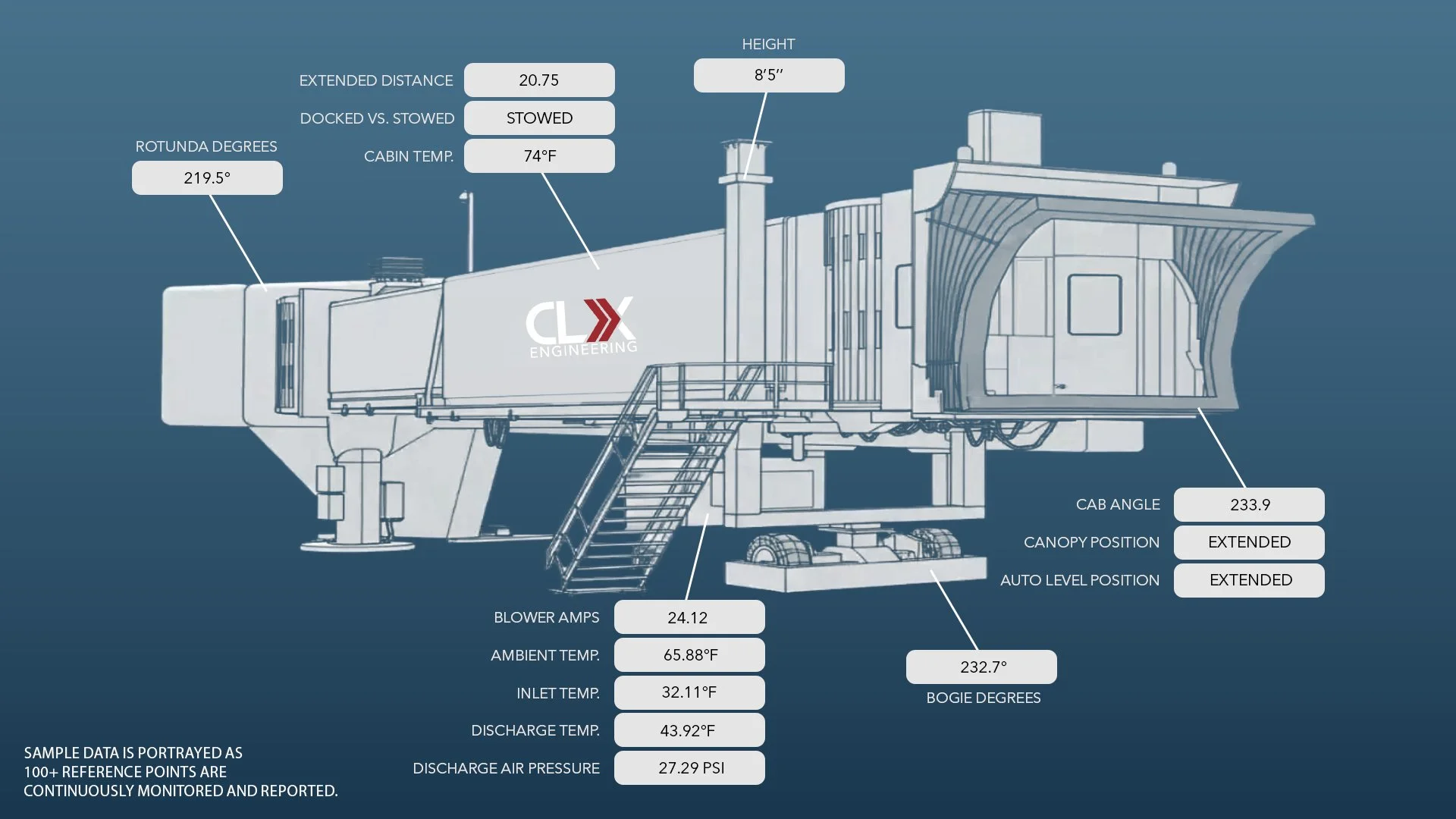
Passenger Boarding Bridge (PBB)
Docked vs. stowed state
Docking duration and utilization metrics
Canopy extension and auto-level positioning
Tunnel extension, elevation, and rotation
Cab, rotunda, and bogie angles (via encoder feedback)
Fault states and operational interlocks
PCAir (Air Handling Unit)
System status (on/off) and runtime accumulation
Temperature measurements:
Ambient air
Inlet air
Discharge air
Cabin air
Discharge air pressure
Blower motor current and load characteristics
Ground Power Unit (GPU)
System status (on/off) and runtime
Output voltage per phase
Output current per phase
Load balancing and electrical performance indicators
Fault conditions and protective states
Data Acquisition Characteristics
High-frequency polling or event-driven updates
Time-stamped data collection for accurate sequencing
Normalization of data across different equipment types
Edge-level buffering to prevent data loss
All data is transmitted to the Upper-Level platform for aggregation and analysis.
Upper-Level Platform (Supervisory Layer)
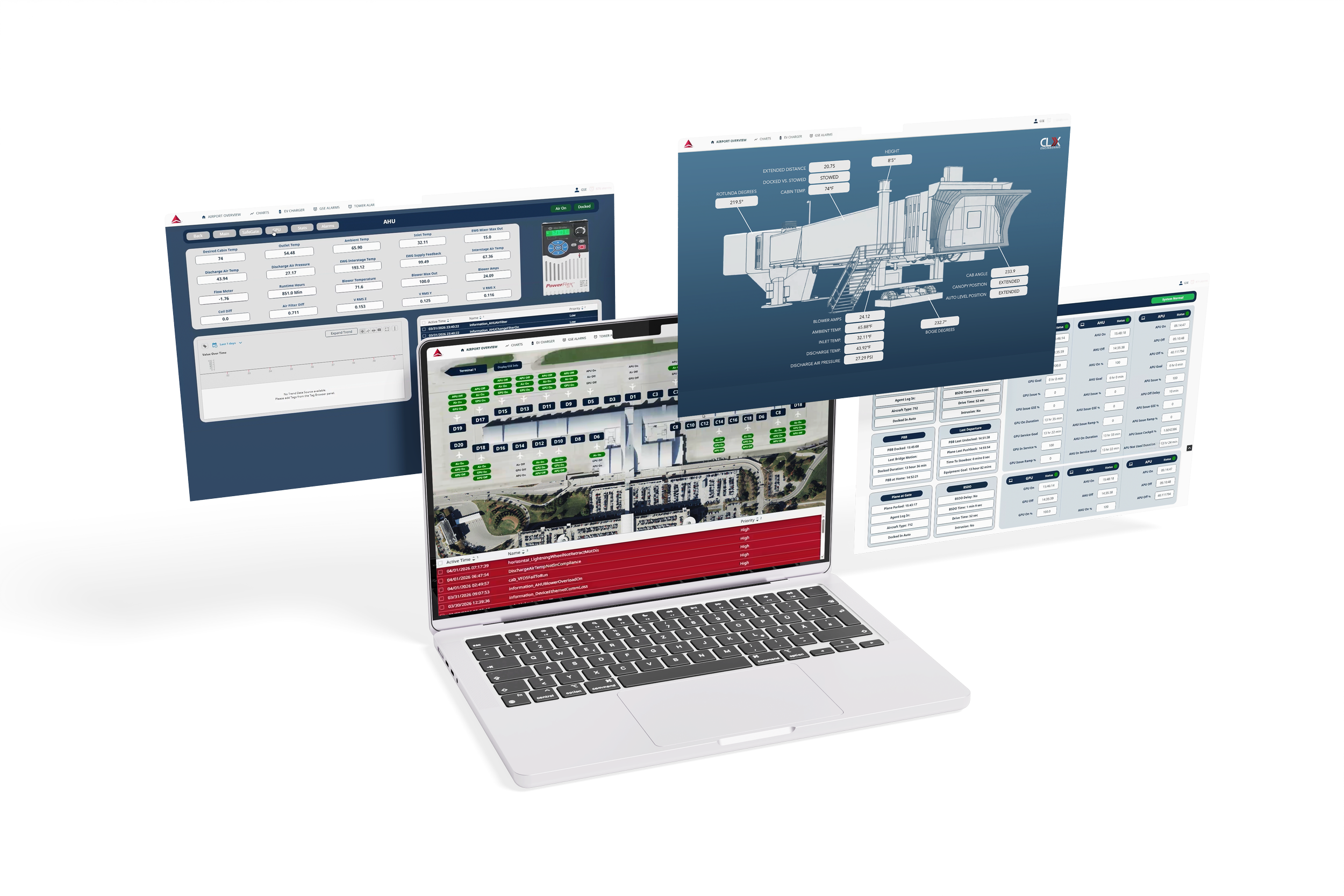
The SIMS Upper-Level is built on the Ignition SCADA platform, providing a scalable, web-based interface for monitoring, visualization, and system interaction.
Core Functionalities
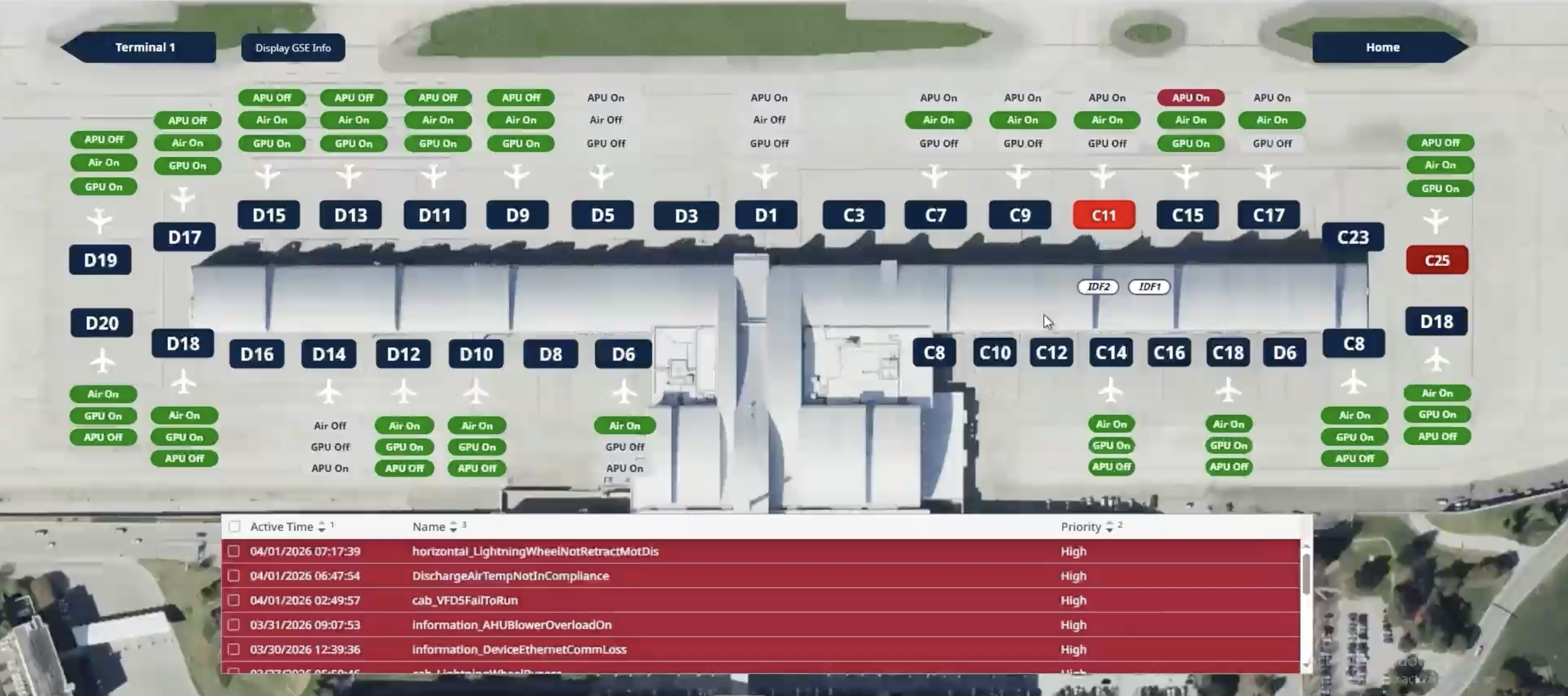
Centralized graphical interface across all gates and terminals
Real-time visualization of system states and equipment performance
Hierarchical navigation from system-level to device-level views
Role-based access for operators, maintenance, and management
System-Wide Visualization
The Upper-Level provides a comprehensive operational overview, including:
Gate occupancy and aircraft presence
Docking status and duration
High-level equipment states (PBB, PCAir, GPU)
Users can drill down into individual gates to access detailed diagnostics, including:
Positional data (height, extension, angles)
Equipment performance metrics
Active faults and alarms
System Integrations
SIMS supports integration with external systems to enhance contextual awareness:
VDGS / Safegate systems
Aircraft docking status
Positioning data
Flight Information Systems
Aircraft type
Flight number
Origin/destination
Operational Data Sources
Tower or airline data feeds
Third-party system interfaces
This integration enables SIMS to correlate equipment performance with operational events.
Data Management, Alarming, and Reporting
SIMS is designed to convert raw data into structured, actionable insight.
Data Management
Full data historization within the Upper-Level platform
Long-term storage for trend analysis and reporting
Time-synchronized data across all systems
Alarming and Event Handling
User-configurable thresholds and setpoints
Real-time alarm generation based on operating conditions
Event logging with precise time correlation
Multi-condition alarm logic for complex scenarios
Reporting Capabilities
SIMS provides a flexible reporting framework that supports both operational and strategic use cases.
Standard reporting includes:
Equipment runtime and utilization
Fault and alarm frequency analysis
Performance trends across gates and systems
Maintenance-related metrics
Custom reporting capabilities:
Stakeholder-specific KPIs
Airline or terminal-specific metrics
Exportable data formats for further analysis
Reports can be generated on demand or scheduled for automated distribution.
Predictive Maintenance and Analytics
SIMS enables a transition from reactive and time-based maintenance to condition-based maintenance.
Analytical Approach
Continuous monitoring of key performance indicators
Trend analysis across historical datasets
Identification of deviations from baseline operation
Early Indicators of Degradation
Increased motor current indicating mechanical resistance
Temperature drift suggesting HVAC inefficiencies
Voltage/current imbalance in GPU systems
Extended docking durations indicating operational constraints
Operational Impact
Reduced unplanned downtime
Improved asset lifespan
Optimized maintenance scheduling
Reduced maintenance costs
By aligning maintenance activities with actual system conditions, SIMS improves both reliability and efficiency.
Integration with Intelligent Gate Operations
SIMS is designed to support advanced and autonomous gate environments.
When integrated with:
Autonomous Passenger Boarding Bridges
APPS (Automated Pilot Parking System)
Pushback Tugs (Autonomous & Manual)
Baggage Loaders (Autonomous & Manual)
Baggage Tugs
Future AGVs
SIMS provides the monitoring and validation layer required for coordinated operation.
Capabilities
Real-time validation of equipment readiness
Monitoring of docking and turnaround sequences
Cross-system visibility between aircraft and gate infrastructure
Feedback loops for operational optimization
This enables a fully connected gate ecosystem where systems operate cohesively.
Operational and Strategic Benefits
Operational Benefits
Improved situational awareness across all gate systems
Faster fault identification and resolution
Reduced operational disruptions
Maintenance Benefits
Transition to condition-based maintenance
Reduced emergency interventions
Improved resource allocation
Strategic Benefits
Scalable platform for airport-wide deployment
Foundation for future automation initiatives
Data-driven decision-making capabilities
SIMS Summary
CLX SIMS provides a comprehensive solution for modernizing airport infrastructure monitoring without requiring system replacement.
By integrating directly with existing control systems, deploying sensor-based monitoring at the edge, and delivering centralized visibility and analytics, SIMS transforms how airports manage gate operations.
The result is a unified, intelligent monitoring platform that improves reliability, reduces cost, and enables the next generation of airport automation.